Macronutrients
Macronutrientt - a substance needed in large amounts. For humans, these are protein, fats, carbohydrates, and water. Vitamins and Minerals are not macronutrients. Chances are, unless every meal you are eating the lowest quality food, you probably don't need to lose sleep over obtaining your vitamin and mineral recommended intake. Macronutrients are what give us energy (not including water), transport nutrients, build muscle, and lose weight, among other functions, but we are going to keep everything specific to fitness. Your activity level and body type will determine how much of any particular macronutrient you should consume. Getting these ratios right based on your lifestyle is essential if you want to take your appearance to the next level.
Breaking Down the Macronutrients
|
Protein-

|
Fats-
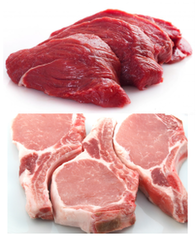
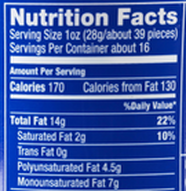
|
Carbohydrates-
|
Activity Level
Like calories, your macronutrient intake is also going to depend on how active you are. Lets assign a numerical value to your activity level on a 1-10 scale. To find out where you fall on this scale, take the amount of times you lift weights weekly and assign a 1.5 value to that. Then, take the amount of times you do cardio per week and assign a 0.5 value to that. Add those numbers together and remember it.
Example: If you workout 3 days a week and do cardio/GET YOUR HEART RATE UP...sure sex can count but not cleaning around the house, for at least 15-30 minutes 2 times a week, your number is 5.5 (1.5+1.5+1.5+0.5+0.5 = 5.5). It does not mater if weightlifting and cardio are done on the same day or separate days. You can only max out at 10 so even if you workout 5x a week and do 5x cardio sessions, your number is still 10. Now that you have your numeric activity level, you may proceed.
DISCLAIMER: I am standardizing activity level (above) and personal body types (below). Of course this is not going to be 100% accurate, but I believe it's a good starting point.
Body Type
Look, I know there is new "research" saying somatotypes (body types) aren't real, but I am going to tell you right now, that's some BS. There are definitely people who can eat whatever they want without gaining weight, and there are definitely people that try to eat whatever they want and gain weight. If you disagree with people having different body types, keep it to yourself.
Your body type will also play a role in how you will balance your macronutrients. Remember from the Training Variables section, you either gain weight easily, lose weight easily, or always seem to stay in shape.
Like calories, your macronutrient intake is also going to depend on how active you are. Lets assign a numerical value to your activity level on a 1-10 scale. To find out where you fall on this scale, take the amount of times you lift weights weekly and assign a 1.5 value to that. Then, take the amount of times you do cardio per week and assign a 0.5 value to that. Add those numbers together and remember it.
Example: If you workout 3 days a week and do cardio/GET YOUR HEART RATE UP...sure sex can count but not cleaning around the house, for at least 15-30 minutes 2 times a week, your number is 5.5 (1.5+1.5+1.5+0.5+0.5 = 5.5). It does not mater if weightlifting and cardio are done on the same day or separate days. You can only max out at 10 so even if you workout 5x a week and do 5x cardio sessions, your number is still 10. Now that you have your numeric activity level, you may proceed.
DISCLAIMER: I am standardizing activity level (above) and personal body types (below). Of course this is not going to be 100% accurate, but I believe it's a good starting point.
Body Type
Look, I know there is new "research" saying somatotypes (body types) aren't real, but I am going to tell you right now, that's some BS. There are definitely people who can eat whatever they want without gaining weight, and there are definitely people that try to eat whatever they want and gain weight. If you disagree with people having different body types, keep it to yourself.
Your body type will also play a role in how you will balance your macronutrients. Remember from the Training Variables section, you either gain weight easily, lose weight easily, or always seem to stay in shape.
- Gain weight easily- You are called an Endomorph. You are "big boned," have a wide waist, and have a naturally slower metabolism. Any macronutrient discrepancies should result in eating more lean protein.
- Lose weight easily- You are called an Ectomorph. You are ""small boned," naturally weak, and have a faster metabolism. Any macronutrient discrepancies should result in eating more healthy carbs.
- Always in shape- You are called a Mesomorph- Your body responds positively to almost anything, congratulations. There is no macronutrient discrepancy other than your food should still have nutritional value.
Application of Activity Level, Body Type & Getting Your Percents
Now, using the numerical value for your activity level, calculated above, and your body type, decided above, choose option 1, 2, or 3.
Option 1. High Protein, Moderate Fat, Low Carb
Ideal for:
Protein: 50%
Fats: 30%
Carbohydrates: 20%
Ideal for:
- Low Activity: <5 (calculated above); MOVE YOUR BUTT MORE. Sitting for long periods of time is very bad for you anyways!
- Body Type: Endomorph, Mesomorph
Protein: 50%
Fats: 30%
Carbohydrates: 20%
|
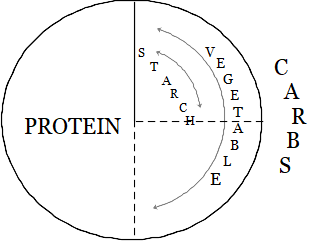
Here is a visual and points to note:
This plate represents any given meal you eat during the day
|
|
Option 2. High Protein, Moderate Carbs, Low Fat
Ideal for:
Protein: 40%
Fats: 20%
Carbohydrates: 30%
Ideal for:
- Medium Activity: 5-7 aka Peak of the Bell Curve; I approve of your activity level.
- Body Type: Very active Endomorph, very sedentary Ectomorph, any Mesomorph
Protein: 40%
Fats: 20%
Carbohydrates: 30%
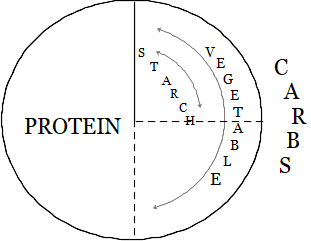
Here is a visual and points to note:
This plate represents any given meal you eat during the day
This plate represents any given meal you eat during the day
- Protein- Will make up 1/2 to the entire plate of what you are eating.
Your protein sources should be really lean, i.e. chicken, fish, game meat, egg whites, fat free dairy. - Carbs
- Starch- No more than 1/4 of entire plate
- Vegetables (Fibrous)- 1/4 to 1/2 of entire plate
- Fat- Will come from lean meat, fat free/low fat dairy, nuts and seeds (in moderation).
Option 3. High Carb, Moderate Protein, Low Fat
Ideal for:
Protein: 30%
Fats: 20%
Carbohydrates: 50%
Ideal for:
- High Activity: >7 ;GREAT JOB!
- Body type: Ectomorph, Mesomorph
Protein: 30%
Fats: 20%
Carbohydrates: 50%
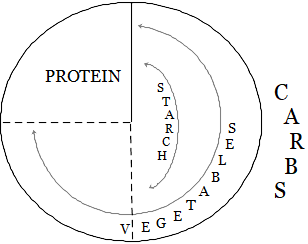
Here is a visual and points to note:
This plate represents any given meal you eat during the day
This plate represents any given meal you eat during the day
- Protein- Will make up 1/4 to 1/2 of your entire plate
- Carbs
- Starch- Should make up 1/2 of your plate
- Vegetables (Fibrous)- Should make up 1/4 to 3/4th of your plate.
- Fat- Will come from lean meat, fat free/low fat dairy, nuts and seeds (in moderation).
Remember to keep your starch carbohydrates whole wheat or whole grain, staying away from processed starches (white flour, "white rice," added sugar.)
Finding Daily Macronutrient Counts- I have my percents, now how much (in grams) should I actually eat?
|
Protein -
|
Fat-
|
Carbohydrates-
|
Things to Note:
- Protein will always end up being around 100 grams or more, even at 30% of your daily intake.
- The biggest factor of how many carbs you should eat how active you are. Not active? Don't eat them!
- If the majority of your fats are not lean, you will probably end up eating too many calories.
Manipulating Your Macronutrients
I am convinced that no matter your body type, you can prevail in reaching your fitness goals by how active you are. Still, it helps to account for differences in genetics.
Endomorph and not losing weight: You NEED to increase your activity level. Your body does not do well with a lot of carbs, so if 1) you have increased your activity level, 2) your Daily Caloric Intake is already at the minimum, and 3) you're still not seeing positive changes, lower the carbs 5% and raise the protein 5%.
Ectomorph and can't maintain your weight: You need to eat more calories. Your body type does well with carbs, so if you are eating as many calories as you can, and if your still not seeing positive changes, increase the carbs by 5% increments, lower the protein by 5% increments, and incorporate more fat in your diet (fattier meats, cooking with butter, drinking milk). If still in vain, maybe you need a Weight Gainer in your life. Mesomorph: You're probably doing just fine.
I am convinced that no matter your body type, you can prevail in reaching your fitness goals by how active you are. Still, it helps to account for differences in genetics.
Endomorph and not losing weight: You NEED to increase your activity level. Your body does not do well with a lot of carbs, so if 1) you have increased your activity level, 2) your Daily Caloric Intake is already at the minimum, and 3) you're still not seeing positive changes, lower the carbs 5% and raise the protein 5%.
Ectomorph and can't maintain your weight: You need to eat more calories. Your body type does well with carbs, so if you are eating as many calories as you can, and if your still not seeing positive changes, increase the carbs by 5% increments, lower the protein by 5% increments, and incorporate more fat in your diet (fattier meats, cooking with butter, drinking milk). If still in vain, maybe you need a Weight Gainer in your life. Mesomorph: You're probably doing just fine.
Summary
If this whole counting thing is too complicated for you to follow or seems like too much work, staying at Level 1 and making healthy food choices will probably work in changing your body composition, just like guessing how much money you have in the bank before your next paycheck and hoping that you have money left over will probably pay your bills . But here is the thing, bodies are complicated and over the years I have really started to believe that a calorie is not just a calorie, and seeing changes really does depend on what type of calories you are consuming.
Protein is definitely a weight-loss and muscle gaining macronutrient. Consuming high amounts will help speed up our metabolism and repair muscle. Protein is so vital (think essential amino acids) that your body will almost always find something to do with it other than store it as body fat. Fats are very misunderstood, and I believe fat plays a very important role in the uptake of nutrients, as well as proper hormone regulation, and keeping you full longer, so the percentage you will be consuming is higher than what you were probably expecting, but not so high that the 9 calories/gram is going to cause you to consume excess calories. Trust me here. Carbohydrates are also misunderstood (they aren't all bad!), but honestly, they don't really belong in an inactive person's diet. Carbohydrates are used for energy and if you are not active, I really don't think you need them, because your body will store them, and over time as your carb storage becomes full in your muscles and liver, they will start to be converted and stored in the form of body fat. If your weight is moving in the wrong direction, I always recommend adjusting your activity level or your carbohydrate intake.
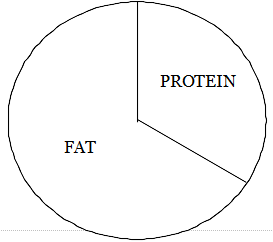
For an easy reference use your plate as a pie chart (see above) and portion your carbs and protein out based on the percentages you need. Since "fat" is not labeled on the pie chart, use the nutrition label on the foods and look at the percentage of calories from fat. Less than half of the calories should be from fat (none of the macronutrient ratios have you eating a 50% fat diet.)
Finally, if by the end of the meal you feel "stuffed," you ate too much. Continuously eating until you are full can stretch out your stomach to the point where each meal you have to eat a little bit more to feel satisfied, and that leads to overeating.
*Note* this does not apply to intermittent fasting where your stomach has time to retract between meals, more in 'Bodybuilder Status' section.
Inevitably, you will think the only solution to this problem is Gastric Bypass Surgery (your stomach gets sown shut) to try and reverse the damage you have done. But really the solution is simple, mindful portion control. The end.
If this whole counting thing is too complicated for you to follow or seems like too much work, staying at Level 1 and making healthy food choices will probably work in changing your body composition, just like guessing how much money you have in the bank before your next paycheck and hoping that you have money left over will probably pay your bills . But here is the thing, bodies are complicated and over the years I have really started to believe that a calorie is not just a calorie, and seeing changes really does depend on what type of calories you are consuming.
Protein is definitely a weight-loss and muscle gaining macronutrient. Consuming high amounts will help speed up our metabolism and repair muscle. Protein is so vital (think essential amino acids) that your body will almost always find something to do with it other than store it as body fat. Fats are very misunderstood, and I believe fat plays a very important role in the uptake of nutrients, as well as proper hormone regulation, and keeping you full longer, so the percentage you will be consuming is higher than what you were probably expecting, but not so high that the 9 calories/gram is going to cause you to consume excess calories. Trust me here. Carbohydrates are also misunderstood (they aren't all bad!), but honestly, they don't really belong in an inactive person's diet. Carbohydrates are used for energy and if you are not active, I really don't think you need them, because your body will store them, and over time as your carb storage becomes full in your muscles and liver, they will start to be converted and stored in the form of body fat. If your weight is moving in the wrong direction, I always recommend adjusting your activity level or your carbohydrate intake.
For an easy reference use your plate as a pie chart (see above) and portion your carbs and protein out based on the percentages you need. Since "fat" is not labeled on the pie chart, use the nutrition label on the foods and look at the percentage of calories from fat. Less than half of the calories should be from fat (none of the macronutrient ratios have you eating a 50% fat diet.)
Finally, if by the end of the meal you feel "stuffed," you ate too much. Continuously eating until you are full can stretch out your stomach to the point where each meal you have to eat a little bit more to feel satisfied, and that leads to overeating.
*Note* this does not apply to intermittent fasting where your stomach has time to retract between meals, more in 'Bodybuilder Status' section.
Inevitably, you will think the only solution to this problem is Gastric Bypass Surgery (your stomach gets sown shut) to try and reverse the damage you have done. But really the solution is simple, mindful portion control. The end.
Bonus: Hitting the Reset Button to Burn Fat More Efficiently
|
Resetting Your Metabolism
For some people that just can't seem to lose fat no matter what they do (I am pretty sure it's related to your activity level though), a cleanse may be necessary. No, not one of those stupid "juicing" cleanses, but rather a Carb Cleanse, also known commonly as Ketosis. As beautifully illustrated in the video, Sean explains how excess carbs become body fat, and how to get your body to use that body fat as energy. For those not familiar, the Ketogenic Diet is a high fat, low/0 carb diet that converts your body to using fat as its primary source of energy, rather than carbs (glucose), forming things called "Ketones" as a by-product. This is definitely not a long-term sustainable diet, but can be used to reset your body and maximize hormone production. |
|